Career and calling
«I want to build a career that doesn't pull against my values»
Choosing a direction, weighing up prospects, moving from employment into your own work — and an honest conversation about what you actually want.

I work with people who want something to change. Coaching does not hand you ready-made answers — you come to know yourself again, and learn to act from what you find.
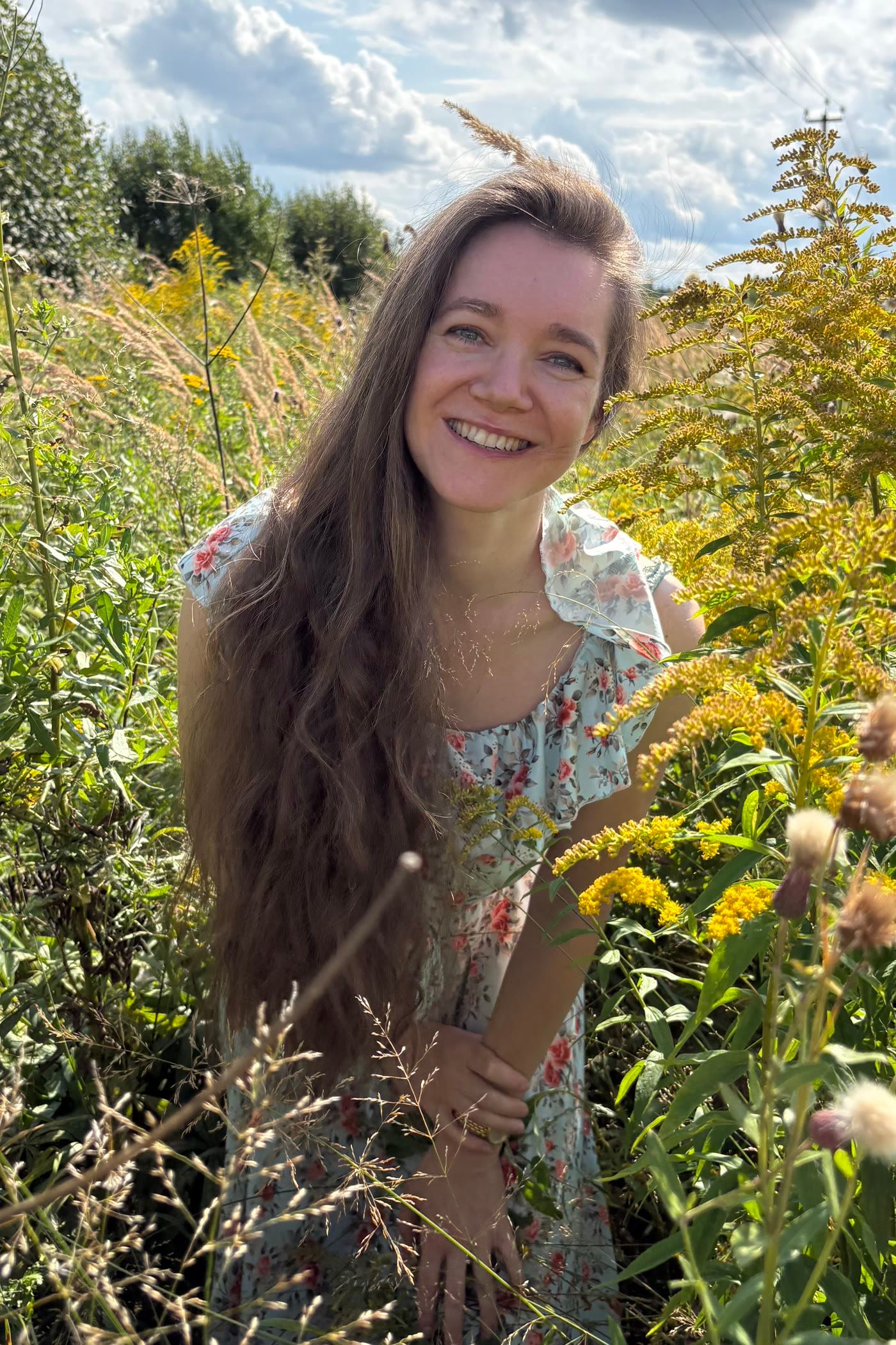
For twenty years I taught English — to people of every age, level and reason for learning. A few years ago I discovered Dogme: teaching without a coursebook, where the lesson grows out of a real conversation. When we talk about what the student brought with them, and there is room in that talk for reflection and experiment, the language settles in easily and naturally. But it is not only the language that grows. The person changes too: trust in themselves appears, a calm relationship with their own mistakes, independence.
That made me think. We learn a new language actively — noticing, trying, stumbling, and moving on that way. Yet we often live our own lives on autopilot, following scripts we stopped noticing long ago. What stops us from getting to know ourselves with the same attention and curiosity — from learning our own life the way we learn a new language? That question brought me to coaching.
My specialisation is life coaching: working not with an isolated problem but with the whole person — their values, and the habits of thinking and living they have grown into.
you feel your life is going in circles, and you want to find your own way through
you want to change a habit, but willpower has stopped working
you are facing a hard choice — about work, a relationship, how you live — and you want to make it deliberately rather than out of fear
you want to be in contact with yourself again, and build a life that rests on your own values
the idea of development as a path speaks to you, rather than a one-off repair
Coaching is a conversation between partners, in which you examine your own situation, arrive at your own decisions, and turn them into action. Good coaching gives you two things at once: an answer to the question you came with, and a growing ability to learn, develop and find answers on your own.
Nobody knows your life from the inside the way you do, and someone else’s advice will not take root until it becomes your own understanding. So I do not give recommendations. I ask questions that help you notice what usually stays outside your field of attention, and I point — carefully — to the contradictions that cannot be seen from within, so that the decision comes out of your own understanding.
Coaching work resembles the way a restorer lifts later overpainting from a picture, layer by layer: your real self shows through from under the familiar roles and other people’s expectations. What is in front of me is not a problem to be solved, but a person — whole and worth something already.
At the same time, coaching is not passive contemplation but active work. It combines uncovering what is already in you with learning. And for an adult it is often more important to unlearn than to learn: to part with the beliefs and habits that once helped and now constrain.
The core mechanism of coaching is awareness. Before you change anything, you need to see which beliefs and automatic reactions are steering your decisions, and where your values have drifted apart from the way you live. Research is consistent on this: it is the growth in self-understanding that makes change hold, and that teaches a person to correct their own course.
A concrete goal: a decision, a habit, a project, a conversation you never quite had the nerve for. We work on what can be done right now, inside the way you already see things.
Deeper: we examine the beliefs the same patterns keep growing out of. What changes is not only the behaviour but the way you think about the situation — and that is how the old circles open up.
Good coaching ends with you no longer needing a coach. What you take with you is the capacity to reflect, to experiment, and to be honest with yourself. The change carries on after our work is finished.

“A good question does not nudge you towards someone else’s answer. It helps you hear your own for the first time.”
Not seeing your own question here? Write to me. In the free session we will work out together whether coaching is the right way to approach your situation.
Message me on Telegram«I want to build a career that doesn't pull against my values»
Choosing a direction, weighing up prospects, moving from employment into your own work — and an honest conversation about what you actually want.
«How do I build a way of talking with my child?»
The conversations that keep going wrong; worry about your children and their future; how to support without controlling.
«I can see myself walking into the same trap again and again — and I still can't stop»
Understanding that has not yet turned into action; what holds the old pattern in place; the first steps towards acting differently in a familiar situation.
«I'm facing a hard choice and going round in circles»
Decisions that matter, and the principles you want your work and your life to rest on.
«I get anxious before anything that matters — an exam, a conversation, a change»
Learning to notice automatic thoughts, to get your footing back, and to turn anxiety into a plan you can act on.
«Everything looks fine, and yet it feels like I'm living someone else's life»
Finding your way back to your own values, looking after yourself without guilt, and habits that actually stay.

From the outside, every helping conversation looks alike: two people, questions, attention. But these are different professions, with different roles, tools and boundaries. I have been lucky enough to learn those differences from the inside — twenty years of teaching, my own experience of psychotherapy, and a full term at Cambridge devoted to the boundaries of coaching.
Psychotherapy more often works with the past and with pain: it helps you recover, manage symptoms, find your footing when it is gone. Coaching faces forward. It is for people who are broadly coping with life but want more — clarity, growth, a better fit with themselves. The central element of coaching is learning and development: the focus is not on symptoms and recovery but on your goals, your values and your growth. A coach does not diagnose and does not work with mental health disorders — that is an ethical boundary of the profession. If I see that what you need right now is therapy, I will say so honestly and help you find the right specialist.
A consultant is an expert in a subject: they analyse your situation and hand you a finished solution. That is the right thing when the problem is technical. But in questions about your own life, ready-made solutions work badly: someone else’s answer cannot account for what only you know about yourself, and it creates no real commitment. A coach starts from the opposite premise — the expert on your life is you. My job is not to give you the answer, but to help you find it and make it genuinely your own.
A mentor is someone who has already walked your road and shares what they learned: “this is what I did — try it yourself.” That is valuable when the road is well described. Coaching is for where the road is your own and nobody has walked it yet. A coach does not offer you their route; they help you lay out yours. Which is why a coach does not need to be more successful than you, or to know your field better than you do: their profession is not the content of your life but the process of examining it.
A teacher knows where the student is supposed to arrive: there is a syllabus, there is a right answer. In coaching nobody knows the right answer, the coach included. We step into open ground together, and what turns up there cannot be planned. For me, moving from teaching to coaching was the hardest and the most important professional shift there has been: to stop leading, and start accompanying.
Not a model, not a technique, not “powerful questions”, but the state and the maturity of the person sitting opposite you. So my first professional obligation is work on myself: supervision, honest reflection on my own mistakes, continuous professional development, daily meditation and qigong.
In the Taoist tradition this is called wu wei — action that does no violence to the natural course of things. I will not nudge you towards the “right” answer, and I will not substitute my goals for yours. Real change does not happen when someone forces themselves to become different; it happens when they come into fuller contact with who they already are.
Awareness comes before change: you cannot change what you cannot see. So I am in no hurry to reach solutions and action plans. Sometimes the most productive thing in a session is to slow down and look clearly, for the first time, at what is actually going on. That can be uncomfortable, and that is normal — an honest look at the problem is not a detour on the way to the goal, it is the first step of it.
Coaching asks for courage from both of us. From me, to be an honest mirror: to give back, carefully, what I hear and notice — including the gaps between what is said and what is done — and not to rush in and smooth over a difficult silence, because that is often where the important thing appears. Every observation I offer is an invitation to look, not a verdict: you are always free to disagree with it. From you it will take courage to look honestly at your own life — and to take new steps.
You set the agenda for each session. You draw the conclusions. You make the decisions. We check in at the beginning, the middle and the end of every session: are we going the right way, are we working the right way, is there anything about the format itself worth changing. This is a relationship between equals. My practice has shown me that an idea offered by the coach is fragile, while an idea the client arrives at themselves stays with them.
Since 1 January 2026 coaching has been formally recognised as a profession in Russia and included in the national classifier of occupations. That matters for the field as a whole — but formal status is only a frame: responsibility for the quality and the safety of the work always rests with the coach.
I am a member of the Association for Coaching (United Kingdom) and I work in accordance with the Global Code of Ethics for coaches. For me the code is not a formality but a lower bound: ethics is not a set of rules on a wall, it is how I make decisions in each particular session.
Everything you say in a session stays between us. The only exceptions are the ones the law requires.
Before we start we agree, in plain terms, on goals, format, cost and boundaries. Those agreements can be revisited — openly, and at any point.
I work only within my qualification: I do not diagnose and I do not work with clinical conditions. If I see that you need a different kind of help, I will say so directly and help you find the right specialist.
I do not impose decisions, do not build dependence on me, and do not extend the work beyond what is needed. The aim of coaching is that you can stand on your own.
I keep learning, accumulate CPD hours through the Association for Coaching, and take my practice to supervision — that is the standard of the profession, and my guarantee of quality.
If I get something wrong, I will say so. If I doubt that our work is useful to you, I will be the first to say it.

An evidence-based approach, practice with real clients, tutor supervision, and the ethics of the profession. Studies completed in June 2026, results confirmed in August. The university’s formal certificate will be awarded in August 2027.
 Association for Coaching, United Kingdom
Teaching English and French.
An international teaching qualification, passed at the highest grade, A.
Grade A, level C2.
In the Young Specialist category.
A couple of lines about yourself and about what you want to change. I answer personally, usually within the day.
We get to know each other, talk through what you want to work on, and you try the format for yourself. Afterwards you decide, without any pressure, whether this way of working speaks to you.
Online, 55 minutes, weekly or fortnightly.
One-to-one sessions online, 55 minutes. In Russian or English.
45 minutes, online. We get to know each other and try the format.
Payment, rescheduling and refunds are set out in the terms of work.

45 minutes online. We get to know each other, talk through what you want to work on, and you try the format for yourself.
Message me on Telegram